
MedNexus Mobile Clinic Development: Bringing SeeFactor CT3 Advanced Imaging Closer to Patients in 2027

Updated: Jun 24
MedNexus News | June 2026
by: Jai Bowie CEO, Co-Founder of MedNexus
Healthcare is moving. Not just digitally, but physically. Across the country, patients are asking for faster access, earlier answers, better convenience, and more control over their health journey. At the same time, clinics, employers, rural communities, senior care networks, and specialty practices are looking for ways to deliver higher-value diagnostics without the heavy burden of building large imaging centers from the ground up.
This is where mobile imaging clinics are becoming one of the most important growth lanes in modern healthcare.

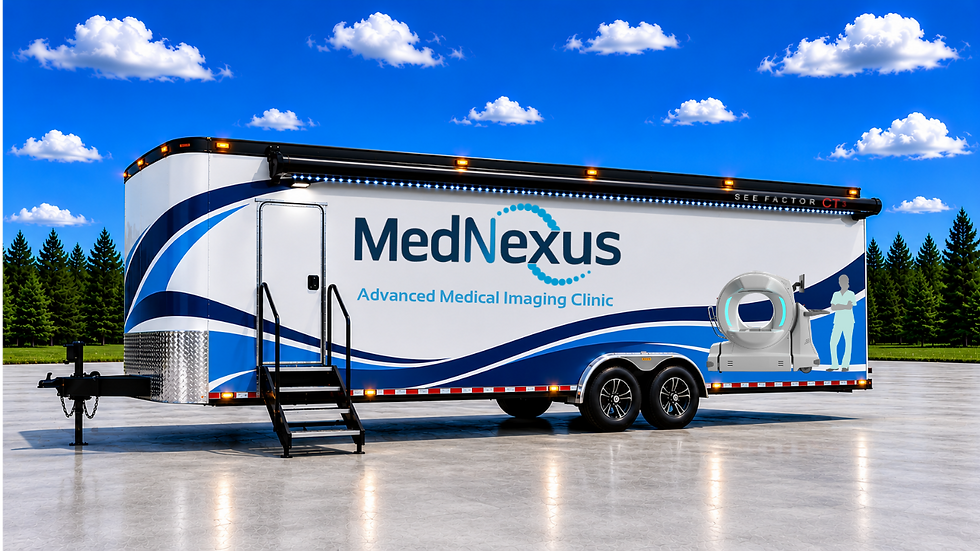
MedNexus is developing its mobile clinic strategy around a simple idea: advanced imaging should not be locked behind traditional hospital infrastructure. It should be deployable, scalable, patient-centered, and capable of reaching people where care is already happening.
The Mobile Imaging Market Is Already Growing
Mobile medical imaging is no longer a fringe healthcare concept. It is a growing segment of the diagnostic services market, driven by patient access, aging populations, preventative health demand, rural care needs, and the continued shift toward outpatient care.
Industry research shows meaningful growth across mobile imaging services. Mordor Intelligence estimates the mobile medical imaging services market at approximately $17.31 billion in 2026, with projected growth to $21.13 billion by 2031. Fortune Business Insights estimates the global mobile imaging services market at $2.13 billion in 2026, growing to $3.26 billion by 2034. IMARC Group reports the broader mobile imaging services market reached $17.4 billion in 2025 and is projected to reach $28.0 billion by 2034, pointing to continued demand for remote diagnostic services, preventative healthcare, and access in underserved regions.
The exact market sizing varies by how each report defines mobile imaging, mobile and fixed imaging, portable imaging, and diagnostic service delivery. But the trend is consistent: healthcare is moving toward more flexible, distributed diagnostic models.
MedNexus Identified Markets In Our Sights
As MedNexus advances its mobile clinic development strategy, the company has begun identifying priority markets where mobile advanced imaging can create the strongest early traction. Based on internal market analysis, the most attractive regions include fast-growing healthcare corridors with strong population growth, outpatient demand, aging demographics, and opportunities for rural or regional outreach.
Initial target markets include Houston, Dallas-Fort Worth, Atlanta, Phoenix, Orlando, Tampa, Charlotte, Raleigh, Nashville, Austin, San Antonio, Miami, Denver, Seattle, Las Vegas, Chicago, Philadelphia, Boston, New York City, Los Angeles, Indianapolis, Columbus, Kansas City, Oklahoma City, and Birmingham.
Minneapolis, Minnesota is also an important strategic market for MedNexus. As a healthcare-forward metro with strong clinical networks, regional access to surrounding communities, and an existing relationship base for MedNexus, Minneapolis provides a logical launch and validation market for mobile imaging deployment.
The broader go-to-market strategy will prioritize markets where mobile units can support rural hospitals, critical access hospitals, cancer centers, orthopedic groups, cardiology practices, neurology programs, outpatient imaging centers, and health systems requiring temporary or supplemental CT coverage. This creates a focused path for MedNexus to scale mobile imaging assets in markets where demand, access gaps, and revenue potential are all aligned.
Why Mobile Imaging Matters
Traditional imaging infrastructure can be expensive, slow to deploy, and difficult to access for many patients. Large hospital-based imaging departments serve an important role, but they are not always convenient, fast, or geographically accessible.
Mobile imaging clinics help close that gap.
They can support rural communities, employer health programs, specialty medical groups, wellness providers, sports medicine practices, senior care environments, and outpatient networks that want access to diagnostic imaging without building a full imaging center from scratch.
Research in radiology and healthcare access continues to highlight the uneven availability of advanced imaging across different communities. Access to high-quality care remains heavily influenced by geography, practice type, and clinical setting, with underserved and rural areas often facing greater barriers to imaging resources. Mobile imaging is also frequently discussed as a way to bring diagnostic services into rural, remote, economically disadvantaged, and geographically isolated areas.
For MedNexus, this is not just a healthcare access issue. It is a business model opportunity.
The MedNexus Mobile Clinic Opportunity
MedNexus is positioned to support a new category of advanced mobile imaging deployment built around flexibility, speed, and clinic-level integration.
The mobile clinic model can create value in several ways:
Faster market entry: A mobile imaging platform can enter a market faster than a traditional fixed-location imaging center. Instead of waiting on full buildouts, long-term construction, or large facility commitments, mobile deployment creates a more agile path to patient access.
Lower real estate burden: A mobile unit can reduce dependence on expensive clinical real estate while still creating a professional, branded care environment.
Better patient convenience: Patients can access imaging closer to where they live, work, recover, train, or receive care.
Scalable clinic partnerships: Mobile imaging can support multiple clinics, referral partners, and provider groups within a defined market.
Stronger regional coverage: A single mobile asset can potentially serve multiple locations, creating better utilization and broader patient reach.
Clearer compliance planning: A mobile model can be structured around defined service areas, operational protocols, licensing considerations, equipment requirements, and state-specific healthcare rules. This matters as MedNexus develops a model that can scale responsibly across multiple markets.
Why the Timing Is Right
Several healthcare trends are pushing mobile imaging forward.
Patients are becoming more proactive about early detection and preventative diagnostics. Clinics are seeking new revenue channels without massive capital exposure. Employers are investing more heavily in workforce health. Rural and secondary markets need better access to advanced services. Technology is becoming more compact, more connected, and easier to support remotely.
Portable and mobile imaging is also gaining attention in the broader medical technology world. A 2026 review of portable medical imaging described it as an important solution for point-of-care diagnosis in emergency, rural, and resource-limited settings where traditional imaging infrastructure may not be readily available. That is the lane MedNexus is building toward.
Not simply more equipment. Not simply another clinic. A deployable medical technology platform that can support advanced imaging services in a more accessible, scalable, and market-responsive way.
From Fixed Clinic Placement to Mobile Deployment
MedNexus has already been developing clinic placement, onboarding, workflow, software, training, and launch processes around advanced imaging integration. The internal launch structure includes prequalification, legal review, financing, facility preparation, network readiness, staff training, technology installation, machine installation, marketing launch, post-launch support, metrics monitoring, quality checks, and long-term operational management.
That foundation matters.
Mobile clinic development is not just about putting imaging equipment on wheels. It requires a complete operating system around patient intake, scheduling, imaging workflow, radiology support, data handling, staff training, compliance, marketing, and ongoing performance management.
The MedNexus opportunity is to take the discipline of clinic deployment and apply it to a mobile platform that can move through markets with more flexibility and long-term upside.
Mobile Imaging as a Revenue Platform
Mobile imaging clinics can support several commercial pathways.
They can serve direct-to-patient preventative imaging campaigns.
They can support physician referrals.
They can create regional partnerships with clinics that do not have imaging infrastructure. They can support personal injury, orthopedic, sports medicine, longevity, executive health, and community health use cases.
They can also become a front-end patient acquisition tool for broader clinical services.
The strategic value is not limited to scan revenue alone. A mobile imaging unit can become a market activation vehicle. It can introduce new patients to provider partners, create community awareness, support education, and build a recognizable regional presence for MedNexus.
This is where the model becomes especially powerful: the mobile clinic is both a care delivery asset and a business development engine.
The Future of MedNexus Mobile Clinics
MedNexus is developing mobile clinic capabilities at a time when healthcare is clearly moving toward more distributed, flexible, and patient-accessible models.
The long-term vision is to build a platform that can enter markets efficiently, support clinics without major disruption, generate predictable revenue opportunities, and create a stronger bridge between advanced imaging technology and the patients who need better answers.
The future of diagnostic imaging will not only be built inside hospitals.
It will be built in communities.
It will be built through partnerships.
It will be built through smarter deployment models.
MedNexus is positioning itself to help lead that shift.
Closing Statement
Mobile imaging is more than a vehicle. It is a new way to think about access, growth, and advanced healthcare delivery.
For MedNexus, mobile clinic development represents a powerful next step: scalable infrastructure, faster deployment, stronger market reach, and a cleaner path to bringing advanced imaging closer to the patient. That is where healthcare is going. And that is exactly where MedNexus intends to be.


Comments